
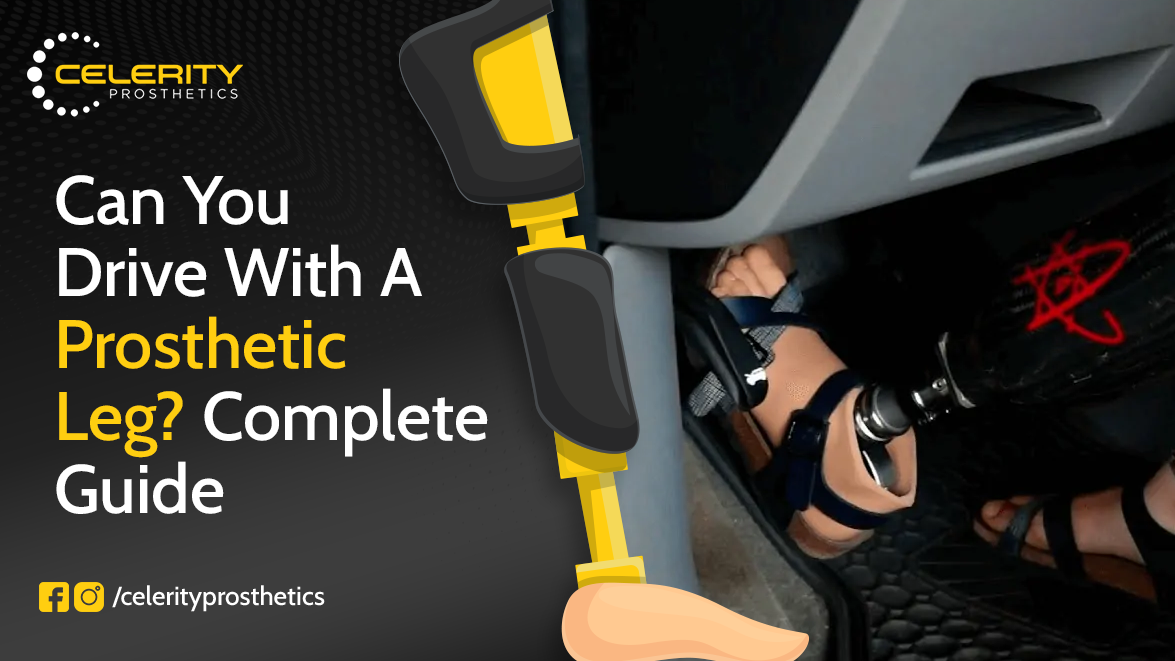
Losing part of a leg affects many aspects of daily life and raises important questions. One of the biggest is: Can you drive with a prosthetic leg? Driving with a prosthetic leg is possible for many people. Many amputees regain the ability to drive safely after recovery and proper adaptation.
Your success depends on factors like the level of amputation and the prosthetic limb’s quality and fit. It also depends on physical strength, coordination, balance, necessary vehicle adaptations, and local licensing rules. Some drivers require only minimal changes, while others need major modifications or alternate control systems to drive safely.
Is Driving with a Prosthetic Leg Possible?
People can drive using an artificial leg. Others who have had a limb removed may safely drive once more after they’ve regained their strength and made adjustments. However, the ability to drive depends on several factors:
- The level and type of amputation (above knee, below knee, both legs).
- The quality and fit of the prosthetic limb.
- Your strength, coordination, and balance.
- Whether your vehicle needs adaptations.
- Local legal and licensing rules.
Some people drive with minimal changes, while others need significant modifications or alternate control systems.
Preparing to Drive with a Prosthetic Leg
Preparation is critical. Jumping into driving without groundwork is unsafe. This section outlines steps to help you get ready.
Medical Clearance and Consultation with Specialists
Start with your physician or medical team. They will:
- Check your overall health and the healing of the amputation site.
- Confirm that no medical issues, such as circulation or balance problems, would interfere with driving.
- Provide formal medical clearance to satisfy licensing authorities.
Then involve your prosthetist (the specialist who designs your prosthetic). Tell them you intend to drive. They may adjust socket alignment, add shock absorption, or choose components better suited to driving stresses.
Undergoing a Driving Assessment or Evaluation
Many regions require a driving assessment, also called a driver rehabilitation evaluation. This is an evaluation by a specialist (often an occupational therapist) who tests:
- Reaction times.
- Control of vehicle maneuvers.
- Cognitive decision-making.
- Ability to adapt to changed control schemes.
This often occurs in a controlled space (parking lot, closed course), then, if safe, on public roads under supervision.
Occupational Therapy Input on Safe Driving
An occupational therapist (OT) experienced in driver training is a helpful partner. The OT can:
- Teach how to adapt movements (knee, hip, residual limb).
- Recommend which adaptive vehicle controls suit you.
- Monitor fatigue, comfort, and endurance during driving.
- Help bridge the gap between medical clearance and real-world driving readiness.
Checking Licensing Requirements and Restrictions
Before driving, check with your local motor vehicle or licensing agency. Key tasks:
- Disclose your amputation or prosthetic use.
- Learn required endorsements or restrictions (e.g., “should wear prosthesis while driving,” “automatic only”).
- Possibly retake parts of the driving test or complete additional exams.
- Understand liability, insurance, and legal compliance.
Vehicle Adjustments and Adaptive Solutions
Many drivers with prosthetic legs need vehicle adaptations. The right solution depends on whether the amputation is above or below the knee, and on which side. Common adjustments include:
- Left-Foot Accelerator – Moves the gas pedal to the left if the right leg is amputated.
- Hand Controls – Replacing foot pedals with hand levers (especially if both legs are nonfunctional).
- Pedal Extensions Or Repositioning – Bring the pedals closer to the driver.
- Steering Wheel Spinner (Knob) – Easier single-hand turning (useful especially for upper limb loss).
- Power Steering, Automatic Transmission, Other Assistive Technology – Reduce the physical effort of steering and control.
An OT or mobility specialist helps choose the right solutions.
Parking, Disability Permits, And Special Privileges
After gaining legal permission to drive, look into:
- Disability parking permits or tags. Many jurisdictions issue them to drivers with mobility limitations.
- Access to reserved parking or preferential zones.
- Exemptions for restricted areas such as city centers or low-emission zones.
- Special vehicle privileges or allowances offered under national or local accessibility laws.
These permits often require documentation of disability or functional need.
How a Prosthetic Leg May Impact Driving
Understanding how the prosthesis might affect driving helps in planning and adapting. Below are key impacts to expect and manage.
Effects on Pedal Operation (Acceleration, Braking, Clutch)
A prosthetic leg typically lacks ankle mobility, sensation, and fine force modulation. Drivers should:
- Rely more on knee or hip movement to control pedals effectively.
- Adjust the force gradually rather than by ankle flex.
- Use pedal adaptations to reduce the gap between the driver and the pedal.
- The clutch is especially challenging for prosthetic users of manual cars; many shift to automatics.
- Also, acceleration and braking can feel less smooth initially. The driver should recalibrate muscle memory.
Balance, Proprioception, and Control Challenges
Proprioception refers to sensing where your body parts are without looking. A prosthesis does not provide natural proprioceptive feedback. You should retrain your perception:
- Estimate how far to move the prosthetic.
- Judge how much force to apply.
- Compensate for the lack of subtle sensory feedback.
- Balance can also shift, especially during sudden maneuvers or when getting in or out of the car.
Fatigue, Limb Discomfort, Socket Issues During Long Drives
Over long periods, the residual limb or socket may cause discomfort or pain due to:
- Pressure points, pinching, or chafing.
- Heat, swelling, or limb volume changes.
- Fatigue in the musculature supporting the prosthetic.
These issues become more pronounced on long drives. To compensate, you should:
- Plan rest stops.
- Monitor the limb and prosthetic fit.
- Carry spare liners, padding, or adjustment tools.
- Avoid overly long drives at first.
Situations That May Require Special Accommodations
Some driving situations may stress your adaptation more, including:
- Emergency or sudden braking.
- Slick or icy roads.
- Uphill starts (manual vehicles).
- Tight maneuvering (e.g., parallel parking).
- Night driving, where small errors are less forgiving.
- Good control, proper adaptations, and training are essential in these scenarios.
Helpful Tips for Driving with a Prosthetic Leg
Here are some tips to make driving safer and more comfortable.
Get Medical and Professional Guidance
Don’t skip the assessments. Regular checkups, prosthetist consultations, and driver rehabilitation input are critical.
Ensure Proper Prosthetic Fit and Comfort
A well-fitted prosthesis reduces pain and improves control. If you feel pressure or instability while driving, revisit your prosthetist. Ask your prosthetist about features designed for driving, such as low-profile feet, flexible adapters, or shock-absorbing sockets.
Choose the Right Vehicle Setup
When selecting or modifying your vehicle:
- Consider automatic transmission.
- Ensure good seat adjustability (height, recline, sliding).
- Check pedal spacing, footwell room, and ingress/egress comfort.
- Test the vehicle with your prosthesis before committing.
- If you will rent or borrow a car, test that your prosthesis works with its pedal layout.
Practice in a Safe Environment First
Begin in a controlled space (empty lot, closed road). Practice:
- Smooth starts and stops.
- Braking under speed.
- Lane changes.
- Parking and reverse maneuvers.
- Emergency stopping.
- Gradually move to light traffic once comfortable. This builds confidence and muscle adaptation.
Pay Attention to Footwear and Accessories
Wear comfortable, secure shoes that will not slip inside the prosthesis. Avoid loose clothing or accessories that might block pedal feel. Carry spare liners or padding for your prosthesis if adjustments are needed mid-journey.
Conclusion
Driving with a prosthetic leg is often possible, but it depends on several factors. Drivers should prepare carefully, receive medical clearance, collaborate with professionals, and pass a driving test. A prosthetic leg can affect how comfortably and effectively a person operates pedals, maintains balance, and drives long distances.
Still, many drivers regain independence and confidence by making the proper vehicle modifications, ensuring their prosthetics fit properly, practicing at secure locations, and adhering to the professionals’ advice. With patience, planning, and support, safe driving can become a realistic goal again. Contact Celerity Prosthetics today to explore the safest options for driving with a prosthetic leg.