
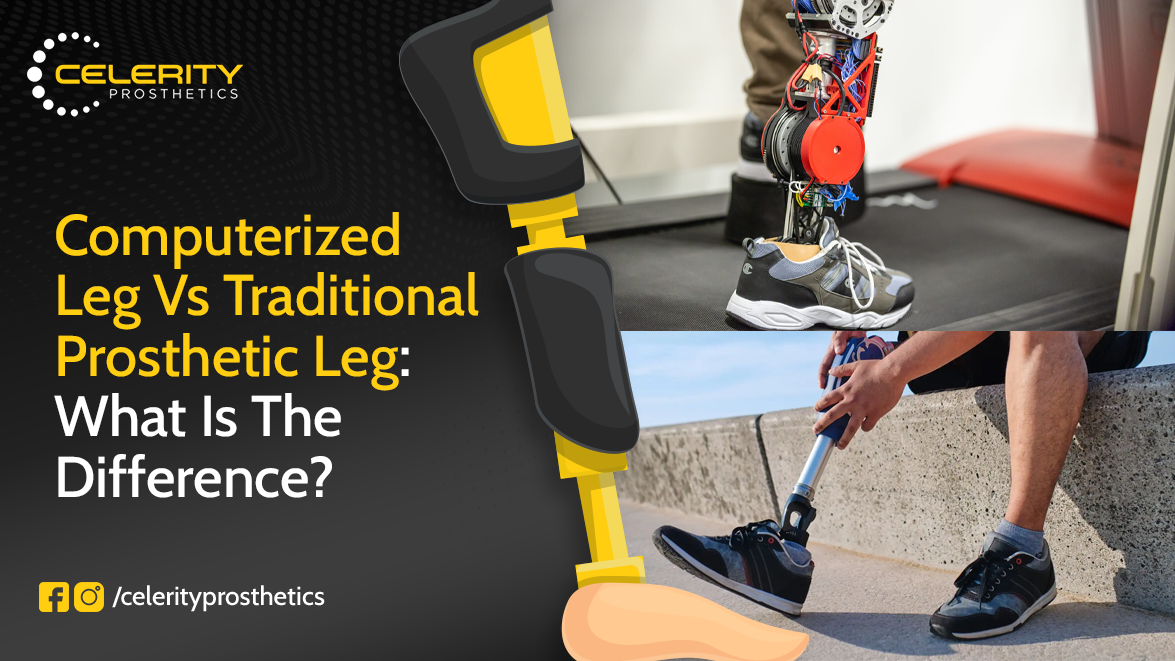
Losing a leg or foot is a life-changing event. A good artificial leg can restore mobility, independence, and confidence. Over time, technology has introduced two main options: computerized and traditional prosthetic legs.
A computerized prosthetic leg has sensors and a microprocessor that monitor real-time speed and adjust joint behavior accordingly. It adapts to speed, slope, and terrain to create a more natural walking experience. However, it is more expensive, requires power, and needs specialized maintenance.
Meanwhile, traditional prosthetic legs do not have these automated controls. They use mechanical parts, such as hinges, springs, or hydraulic dampers. These legs are simple, durable, and affordable, but they demand more physical energy and offer less adaptability on uneven ground.
What Is a Computerized Leg?
A “computerized” prosthetic leg typically means one with sensors and a microprocessor (small computer) that monitors real-time motion and adjusts joint behavior accordingly. In practice, these are often called microprocessor knees or feet.
How does it work?
- Sensors detect movement, angle, speed, and force (for example, how fast the person is walking or how steep a slope is).
- The microprocessor (controller) processes these signals and sends commands to actuators or hydraulic elements in the joint.
- In response, the joint (knee or ankle) changes its resistance or flexibility, adapting to walking speed and terrain.
- Some models instantly lock or slow the joint to prevent stumbling.
Pros
- More natural gait: The leg adjusts to changes in speed or ground, making walking smoother.
- Reduced user effort: Because the leg helps, the wearer may expend less energy.
- Safety features: Sudden locking or adaptation can reduce the risk of falls.
- Adaptability: Useful on slopes, stairs, and varied surfaces.
Cons
- Cost: These are more expensive than mechanical types.
- Maintenance: They require software updates and more specialized servicing.
- Weight and power: Added sensors and electronics may make the leg heavier or require battery charging.
- Access: There may be limited availability to the necessary specialists in some regions.
What Is a Traditional Prosthetic Leg?
Traditional prosthetic legs are mechanical or non-computerized. They rely on mechanical systems such as hinges, springs, hydraulics, and pneumatic mechanisms without active computing control.
How does it work?
- The user controls movement through their own motion and the prosthetic’s mechanical parts.
- Joints may use friction, springs, or hydraulic dampers to resist swinging or provide stability.
- Some designs lock or resist motion when weight is applied (a weight-activated lock).
- There is no active sensing or adjustment based on changing terrain.
Pros
- Simplicity: Fewer parts and no electronics mean a simpler design.
- Durability: Less prone to breaking; they often last longer under rough use.
- Lower cost: Much more affordable than computer-enhanced versions.
- Easier repair: Mechanical parts can often be fixed in more places, even remote or less specialized clinics.
Cons
- Less adaptability: The leg won’t adjust automatically to terrain or speed changes.
- Higher energy cost: The user must supply more effort to control motion.
- Less smooth movement: Transitions (start, stop, slope) may feel jerky or require extra control.
- Limits: Harder to manage stairs, slopes, or uneven ground naturally.
Key Differences Between Computerized and Traditional Legs
| Feature / Aspect | Traditional (Mechanical) | Computerized (Microprocessor) |
|---|---|---|
| Control method | Relies entirely on mechanical parts (hinges, springs, friction dampers) | Uses sensors and a microprocessor to adjust joint behavior dynamically |
| Energy / Effort required | High: user supplies most of the force and control | Lower: device assists, reducing the user’s exertion |
| Stability & safety features | Passive: stability comes from mechanical resistance or locks | Active features: can slow, lock, or adjust instantly to prevent stumbling |
| Shock absorption & comfort | Depends on mechanical dampers or cushioning; less adaptive | Better at absorbing impact, adjusting for slope or uneven ground |
| Weight & bulk | Usually lighter (no electronics) | Heavier due to sensors, actuators, battery, and electronics |
| Durability & ruggedness | Highly rugged, fewer delicate parts, less vulnerable to the environment | More sensitive: electronics may degrade in moisture, dust, and extremes |
| Maintenance & repairs | Easier to find repair parts; local prosthetists are more likely to fix | Requires specialized servicing, calibration, and software updates |
| Battery & power needs | None (fully mechanical) | Needs power: battery charging, battery life management |
| Initial cost | Lower (affordable design and manufacturing) | Much higher (sensor systems, research, electronics) |
| Operating cost | Low maintenance, minimal recurring costs | Ongoing costs: servicing, electronic parts, software, battery replacement |
| Accessibility & supply | Widely available, many local suppliers | Limited suppliers, fewer regional service centers |
| User experience & gait | Reliable and functional, but the gait may feel somewhat mechanical | Closer to natural walking, more confidence with slopes and stairs |
| Long-term wear and tear | Wear concentrated in mechanical joints, springs, and surfaces | Wear also affects electronics, sensors, and battery performance over time |
Factors Influencing Choice Between the Two
Several factors matter when deciding between a computerized leg and a traditional one. Here are key considerations:
Patient’s Lifestyle
- A computerized leg benefits people with active lifestyles, such as those who walk long distances or climb stairs.
- A mechanical leg may be helpful if the mobility goal is basic, such as walking indoors or on flat surfaces.
Financial Resources And Insurance Coverage
- Limited insurance or financial resources may make the lower cost and easier maintenance of mechanical legs a deciding factor.
- If funding and coverage permit, a computerized option may yield long-term gains in comfort and energy savings.
Age and Health
- Children and young people grow. They may quickly outgrow a prosthetic, so a less expensive mechanical leg might initially make more sense.
- People with balance or strength challenges may benefit more from computerized legs.
Environment
- Mechanical legs may be more robust and serviceable in rural or rugged terrain with limited repair infrastructure.
- In urban settings with smoother surfaces and better support networks, computerized legs realize more of their advantages.
For Animals (If Used In Veterinary Prosthetics)
- Species, weight, behavior, and acceptance of a prosthetic matter. Many computerized systems for animals are still experimental.
- If the animal won’t tolerate frequent checkups or maintenance, a strong, simple mechanical prosthetic may be more suitable.
Conclusion
Computerized and traditional prosthetic legs each bring useful strengths and trade-offs. A computerized leg uses sensors and a microprocessor to adjust joint behavior automatically, giving smoother motion, less effort, and safer walking in varied terrain. A traditional prosthetic leg relies on springs, hinges, or dampers without active control. It costs less, lasts longer under rough use, and needs simpler maintenance.
The best choice depends on lifestyle, budget, health, environment, and availability of support. Traditional legs often meet basic mobility needs, while computerized legs offer more comfort and function if resources allow. Contact Celerity Prosthetics to choose the right prosthetic leg based on lifestyle, health, and resources.